Digital Illustration

After reading other people’s posts I noticed that like a lot of people in the class, the collage workshop was much more enjoyable for me than the digital illustration. I am not a really good artist and I doubt anything will change that, but collaging actually allows me to create some type of art by just being creative and combining small parts from different sources. There are really no limits to what you can create with a collage and I will definitely by using this method for my final illustration.

However, I found the digital workshop challenging, in part because there were a lot of glitches and because unlike manual art making, if you’re not very technologically apt like me, it was quite frustrating not being able to create what I was picturing in my head and would have been able to produce on paper. I think another reason the process was difficult was that we got a short tutorial and that one class period is obviously not enough to master the whole program. I had never done anything like it before so I felt I faced a lot of limitations in what I was trying to create. Overall though, digital illustrations are perhaps the most modern way of making art and I really enjoyed the experience and getting to try it.

Workshops

The workshops this week were enjoyable, to a degree. I enjoyed collaging, as it is something that I have done since I was a child. I was never good at drawing or painting, and so my creative options were relegated to exercises in coloring books and and collaging. I worked with the local newspapers to make a collage of the sections I found to be most prominent and of the most interest to me. The exercise was enjoyable, and in a way therapeutic.

Todays workshop with adobe illustrator was more difficult. I had trouble finding the colors and shapes that I was looking for. The process itself didn’t feel at all organic, and was quite honestly boring  for me. Even though I cant paint or draw, I enjoy working with my hands more than I do on the computer. It’s an interesting medium over which to create, and I’m sure those more apt artistically can find ways to make beautiful pieces of art, but I don’t think digital illustration is the thing for me.

Whether its Digital or a Hand Illustration I Still am a Horrible Artist.

This week truly opened my eyes to my lack of artistic ability.  I knew before this that I could not draw or paint to any significant level of skill, but now I can officially say that technology and I are not friends as well.  However, my lack of artistic skill aside, I do think that it was an incredibly enjoyable week of workshops.

Starting with the first workshop on Monday morning, I was taken back to elementary school art class where I was practicing my collage techniques, and I really enjoyed having complete freedom to cut and place things wherever I was originally driven to place them.  For Monday’s workshop I chose to cut out all of the things that interested me when I noticed them flipping through the magazines.  As I collected all of these seemingly random pieces, I started to see a story forming that eventually turned into the collage I created.  The randomness was able to become a story, which intrigued me because even though I felt random I guess I was not being random.

Today in the Digital Illustration Workshop, I had the opportunity to once again be disappointed in myself as a future artist.  While I have already harped on this point, I did manage to get a lot more out of it beyond my shortcomings.  I thought it was really interesting to see how much more complicated digital illustration is than it looks.  I also  got to experience how many potential things you can do with the computer in the digital illustrator.  I experimented with a few different techniques when I was creating my pieces.

So while at the end of the day I learned a lot about my inabilities, I still got a lot out of using these programs and techniques that I haven’t been able to try before this week.

Visual/Textual Collaging

As many others have said, I really enjoyed Monday’s collage workshop. I didn’t have much of a direction when I began, but I found it was interesting to forego the use of scissors at times and rip out certain shapes with my hands. While purely visual collages are often beautiful and provocative, I was interested in introducing words into mine because I’m a creative writing major. I love playing with language on the page, and I was curious to mix poetic and visual play. I generated a loose theme about reading/poetry and teaching by using a large image of a grandfather reading to a child. I love using words as a decorative element too, so on one side of the collage I wrote “Teach your children well” (from the song by Crosby, Stills, Nash & Young) repeatedly to create a background in which the text is nearly indiscernible. I also used small bits from the magazines from the 50’s (I think they were called something like “Lifetimes), which had lots of poems and small stories within them. Repurposing and rearranging words in a new space and context really intrigues me. I took words and phrases from different portions of the magazine to make up no poetic fragments. For example, “Casual acquaintance/on my sunlit floor” and “Lead limbed/ lover/ in the kitchen.” It reminded me of magnetic poetry-the random word arrangements that people throw on their refrigerators. The realm of possibility for this type of wordplay is endless, and I love that. If we had more time in class, I would have continued to scrap different words and phrases from disparate sources to create new pieces of poetry, and perhaps create a more coherent poem? In addition to mixing the sources from which I gathered words, I also took this opportunity to play with different mediums in collage. I used glue and crumpled tissue paper (which I haven’t done since kindergarten!) as well as glitter, and even pieces of the Hamilton campus map. As collage itself is a conglomeration of disparate elements,  the open-ended nature of this workshop was quite fascinating and fun for me.

Is it play if you’re not having fun?

Okay, I’m about to say something provocative: I was not a fan of today’s photoshop experimentation. I couldn’t figure out the buttons. I couldn’t find the colors I needed. I couldn’t add, erase, or draw the things I wanted, where I wanted. To summarize, today’s class was a frustrating one.

I think a lot of this has to do with my background as a painter. I want to reach out and touch the page. I want to move things around with my own hands, not with a curser. “Playing” around on photoshop felt like trying to use chopsticks with mittens on. Why use photoshop when we could use real, 3D objects?

Yeah, maybe I’m being stubborn. Technology has never really been my friend and it’s probably a bad outlook of mine to just ignore all things computer. But why bother if it makes you frustrated? I don’t think it’s fun, so why bring about the headache?

While photoshop may feel like play to some, it feels like work to me.

Playing with Adobe Illustrator

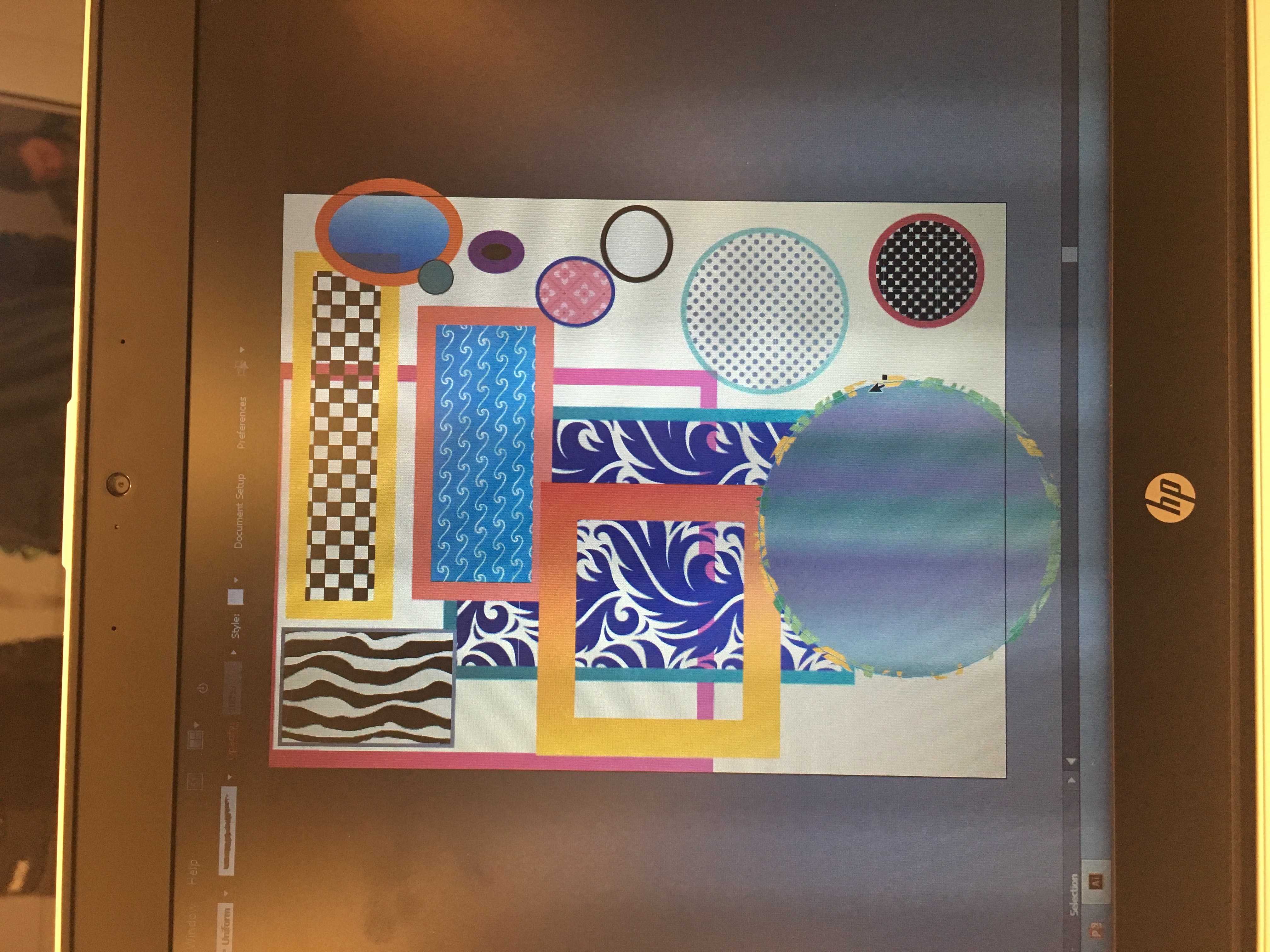
I had never used a digital platform for illustration before today’s class. Adobe Illustrator has endless of options for creating playful illustrations and allows users to gain a different perspective on what it means to illustrate. Before using this digital platform, I thought it would be more restrictive than freely drawing in the material world, however, I found that I could incorporate even more interesting elements into my work. For example, from the picture I’ve added below, you can tell that I was interested in playing with shape and patterns, which I would not be able to execute as cleanly with actual art supplies. I did not have a plan going into today’s workshop, but after exploring the options Illustrator has to offer, I would be interested in going back to it and creating something like a poster with text. I think it would be fun to compare the work we did with at the printing press workshop and see if one method is more effective or appropriate for certain projects. Did you prefer working with new digital technology or the printing press?

“Playing Was Different When I Was a Kid”

For my final project, I will be working with the book My ’70s Book: The “When I Was A Kid…” Book For The Generation That Grew Up In The ’70s by Darryll Sherman. In this book, the author is reminiscing about the good old days and various forms of play that he participated in as a child. He talks about how he played outside, played board games, played cards, played the piano and various other things. He also comments on how children’s play now is so different from what it was back then. Nowadays, play largely involves technological devices. He personally prefers his version of play (and I agree with him!)

I chose the book after the collage workshop. I was lucky enough to find a story that fit my collage. Currently, the collage shows a man (the author) recounting his childhood to his wife. Underneath them are the memories of his play. The chess board represents the board games that he played. The three characters in the front are the author, his brother and his sister who he mentions in the book.

Now that I have the book, I will add more elements from it to the collage such as music and instruments. I will also add a quote from the book. I will do some more collaging and draw somethings by hand or use what I will learn in the digital workshop. I am excited to finish this project!

Also after making this collage, I really admire Max Ernst. Cutting and pasting images turned out to be so much more difficult than I had initially anticipated. I commend his patience and how quickly he completed entire stories completely in collage. Props to him!

American Beauty

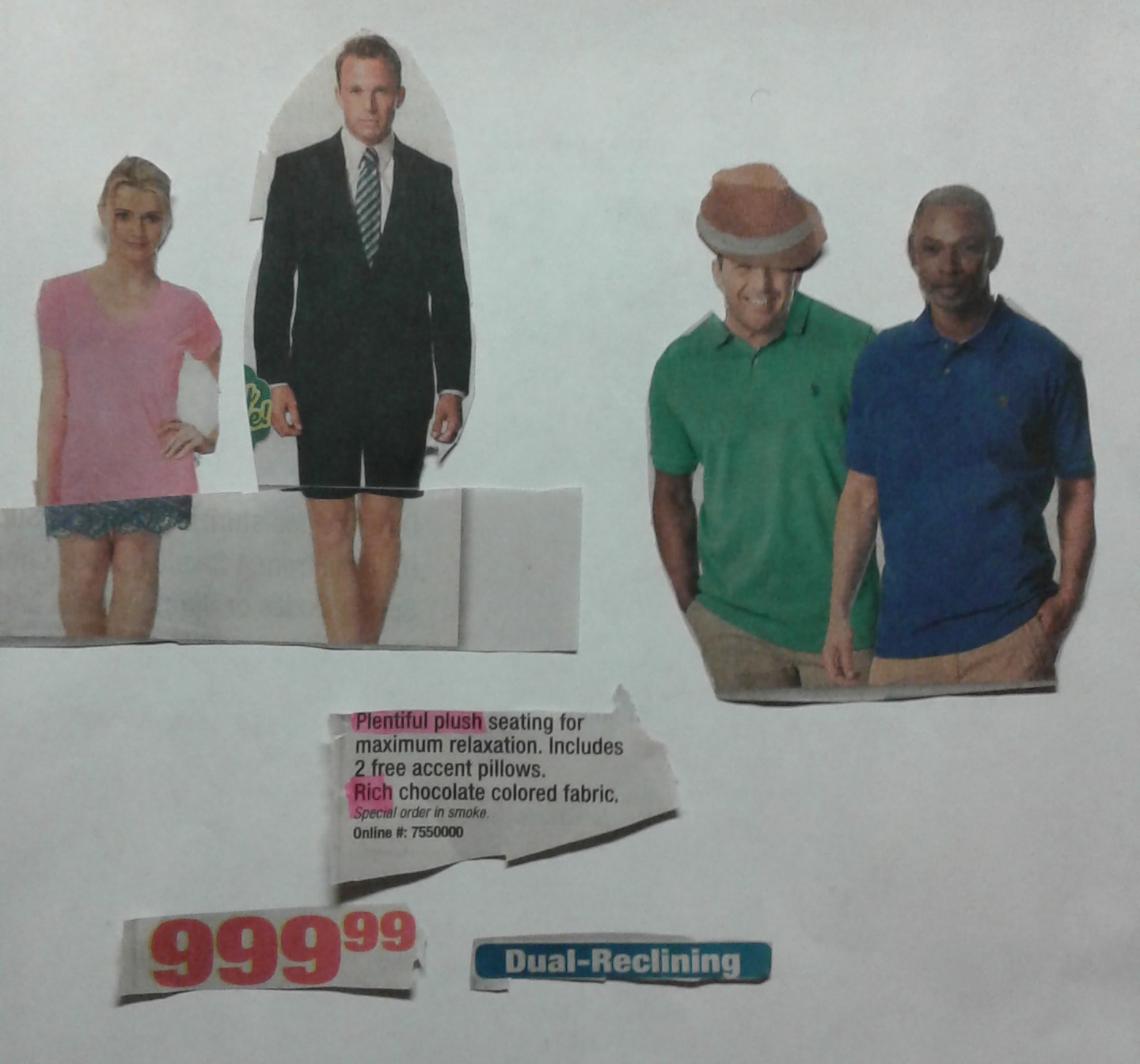
I really enjoyed the activity we did on Monday. I was trying to deal with themes of body image and the narrative that American fashion places on people of all genders. I know the idea has probably been done before by collage artists, and I am sure it has been tackled by artists that work in other mediums, but it was a new area for me to tackle. I wanted to show the absurdity and specificity of the American standard for “what looks good”. I was also interested in how that is portrayed. I felt that the catalog portrayed a strong sense of male and female archetypes in order to sell the images. The men and women wore typically straight cis-gendered clothing that appealed to the typical traits of masculinity and professionalism, and femininity and style, respectively. I wanted to play around with these images to see what implications arose when I mixed and matched the traits of the different traits the models seemed to portray. So, I cut out some of the heads of the models and placed them on the bodies of different models. I also replaced some of the men’s legs with women’s legs.

I was inspired by how the catalog creators chose the images and the models they thought would appeal to a general audience. They had men’s bargain suits, blazers, and pants. They also had women’s blouses, pants, purses, and hats. These are pieces of clothing that everyone needs at some point in their life (women’s accessories and the men’s clothing are not everyday essentials, however). In other words, the catalog, based on the items it featured and the models it featured, is meant to appeal to everyone between the ages of 18 and 55. The catalog creators do not necessarily want to discriminate a certain demographic from buying their material. On the contrary, they want everyone to buy their products – they want the most business possible, after all. However, I did find it interesting that the models they showed wearing their products were mostly young or youthful-looking, attractive white men and women. This, of course, is nothing new – catalogs and magazines have always used these kinds of models because that is what looks best and that is what sells their product.

The problem for me arises when companies expect people who do not look like their models to buy their products. Again, this is nothing new and I am sure most people have recognized this by now, however it exposes a problematic presumption that companies have about the American consumer: it is that the American consumer will buy anything in a catalog that looks appealing in order to make themselves become more appealing. Why do we automatically default to young, white attractive people when considering if we should buy something to make ourselves look better? The obvious answer is that the majority of people who look at these catalogs will likely be white. But what about the people who are not white? Are they to buy the items from the catalog too? There is an unintended arrogance embedded in the composition of these catalogs that non-white consumers should buy these products even they are not considered or minimally considered. That said, there were a few black male and female models. To be clear, it’s not that having predominantly white male and female models is inherently wrong – on the contrary, it makes sense to have so many of these kinds of models. But, in an America headed by the Trump administration (and all the social implications that that title entails), and in a time when Americans seemingly or split on key societal issues, it is worthwhile to take a closer look at images we so often take for granted and deconstruct why we believe in them or why we agree with them. The same arrogance (or ignorance, or apathy) that catalog creators have when catering to its audience, is the same arrogance that Donald Trump has as he sets the tone for his presidency in a post-Obama America. In turn, this arrogance will inevitably be “bought” by those who choose to support him and so lives on the cyclical nature of arrogance. It is not that Donald Trump is necessarily a bad person, just like the catalog creators did not set out to marginalize minorities, it is that when these images and ideas are consumed by the masses, we are buying into ideologies that may end up hurting us.

Monday Morning Workshop

Having not created a collage since I was in elementary school, our exercise Monday morning was quite the throwback for me. To reiterate a point that Professor Serrano stated during our class, it was a very relaxing experience. Bringing together images and scraps from numerous magazines and creating something on a blank piece of paper was quite rewarding. I found that I lost track of the time and was completely focused on thinking about the direction of my collage. Personally, I am very un-artistic. However, I found that making a collage was more about creativity and vision. Because of this, I felt more confident in the process and wasn’t self-conscious that my final product was going to be terrible.

While I am excited for our digital workshop on Wednesday, I know that for my final project I will be making a collage. The relaxing nature of creating a collage combined with the fact that strategic/creative planning are the key elements in being successful really appealed to me. I look forward to starting my final project!

Collage workshop

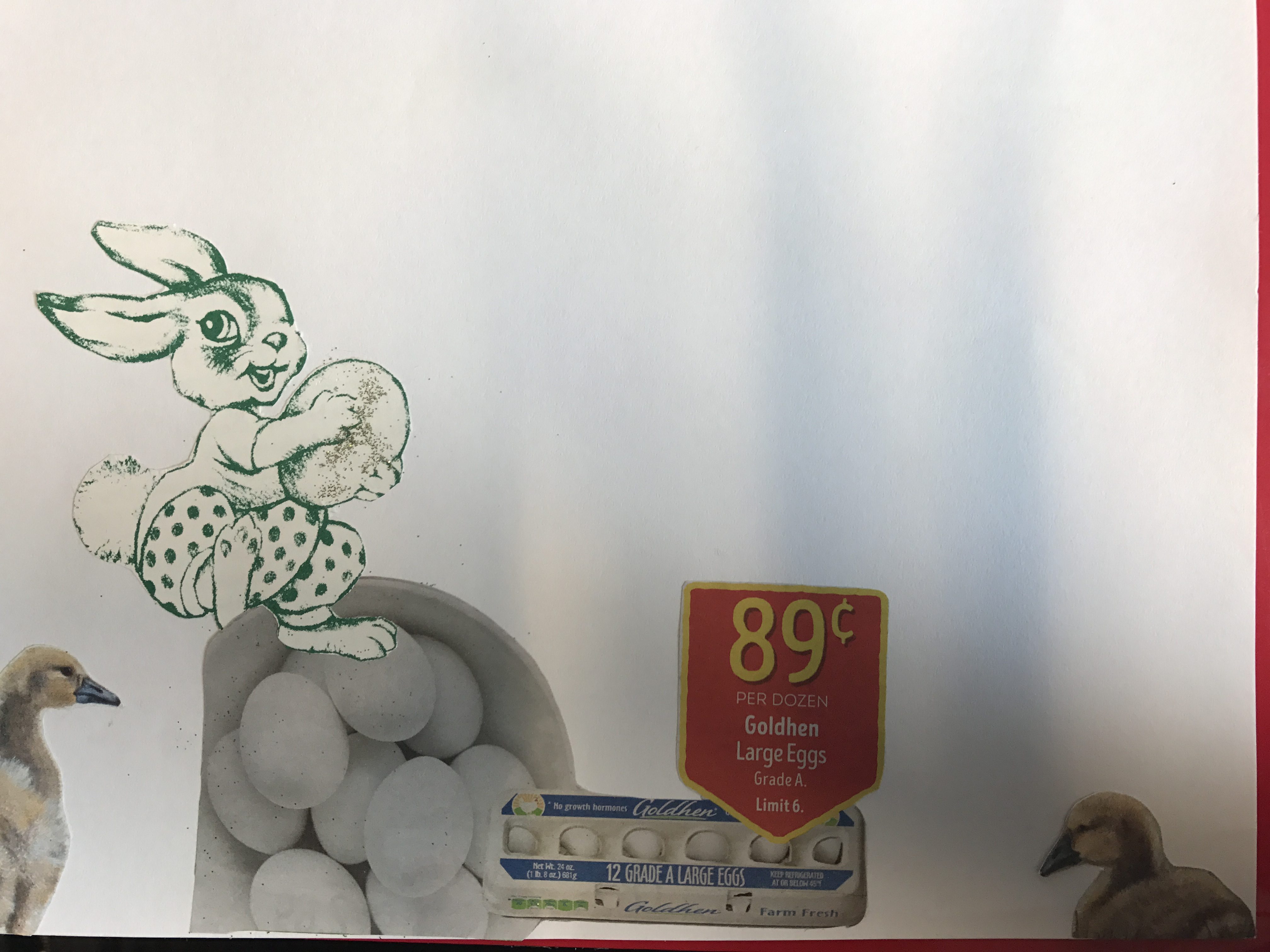
The Monday’s Collage workshop was so much fun. Because of the Julia Jacquette’s exhibition on meat and salads, my eyes were  immediately to the supermarket promotion pages and found the bowl of eggs in the image above. The eggs then reminded me of the past Easter and bunnies, so I looked through another magazine called ‘Easter Ideal’. The green bunny on one of the pages was really catchy. At the moment I saw it, I started to wonder if I could not only create a picture, but imposed a story about the green bunny stealing eggs from the ducks’ houses like those stories in children’s books. Also, I am always wondering about the origin of Easter and its relationship to eggs and bunnies, so it will be great to have another story to tell kids about Easter just like Santa Claus to Christmas. Thus, I found two ducks in the same magazine and the only thing left would be the background.

I should have done the background first before I glued any of the figures. I started to realize how hard it was for Max Ernst to build the structure in his minds and finish the whole book in three weeks. He must have had a nature of talent and a passionate soul to work days and nights on it. Since our class will cover another children’s book on bunnies next week, I figure it would be a good idea to include this collage into the final illustration project.

css.php