Personal Nature of Memoir

Julia Jacquette’s Playground of My Mind can be defined as a visual memoir. Although it does not go as in depth into her personal history as a typical memoir would, its visual elements present their own ways of creating a personal feel to the book. One way in which Jacquette accomplished this is through the appearance of the text, which looks as though it has been hand-written. The look of having every word written out by hand imbues the text with more personal meaning and importance than can be felt by looking at the text of a typical printed book, which gains import only after it has been read. The handwriting works together with the placement of the images and the way that these pictures are presented almost as looking like polaroids to create a kind of scrapbook feel.

Another strategy Jacquette uses to create a more intimate feel to the book is leaving some of the pale gray and blue lines she used to plan out the spacing of the pages in the background, as can be seen in the image above. This allows the reader/viewer to feel as if they are getting an inside look into Jacquette’s process of creation. The lines are made even more interesting with the fact that they are only included in some pages, while other pages have totally clean white backgrounds. This reveals the intentionality of leaving the lines behind, possibly as a device to draw in the reader.

Julia Jacquette– “Hands (Women Rock Musicians)”

When looking around the exhibit today, the piece that struck me the most was the first one we saw– “Hands (Women Rock Musicians)” series, 2016. I thought the medium of glazed ceramic tiles gave these paintings a stunning, three dimensional presence.  Hearing Sungmin’s take on the piece was very interesting to me. He explained that Julia Jacquette wanted to convey the more realistic elements of female hands. In advertisements and media, female hands are often perfectly smooth, delicate, and free of scars or blemishes. Julia paints these hands in their realist forms, and choosing to convey the hands of famous female rockers is even more bad-ass in my opinion. There is something completely raw and powerful about these images, and it felt like a very positive expression of art, rather than some of the more critical and negative paintings later on in the exhibit. 

Julia Jacquette’s Exhibit

Looking at Julia Jacquette’s pieces made me think a lot about depicting the ‘personal’ in art. After going through some of the pages of her book and walking through her exhibit with the guide, I wondered how each aspect of this experience must have been like for her. The first aspect I thought about was endeavoring to distill your experiences and emotions into something tactile and possibly stagnant in its movement (paintings for example). Was it incredibly stressful to try and show that? Does everything she’s created feel perfectly honest and an accurate depiction of what she imagines in her head? Are the stakes of all of these perfections and truths higher because this is about her and about the people she loves? When she depicts her mother, for example, does she worry that she will offend her or offend her own memory of her?

A second stage I thought about was pitching these ideas to other people, trying to get them to take her work professionally. If work was ever rejected, did that feel like a personal rejection of her life story and the way she decided to show it? Of course, most art has a degree of ‘the personal’, but I imagine that memoire work is more directly so.

A third quality I imagined was the way that the public reads your work once it’s out, their degree of personal interest or enjoyment of it. Did she worry that people wouldn’t associate the same objects that she depicts with the exact emotions that she cites? Was it more important to her to show how she felt or appeal to something that she hoped others felt? The work below is an example of this – the sensuous quality of the cream and the sweetness of the dessert could possibly be associated with intimacy for anyone, but it’s application seems to be one that’s specific to her own experience.

The Tragedy of the Hapless Child

Gorey’s Hapless Child was so striking to me after we read it in class today that I’ve been thinking of it since. After going back to it for the second time, I noticed many things I didn’t see the first time. For example, the little girl appears in the pristine white dress in the first pictures, almost glowing with happiness. Then at the school she’s clothed in black but returns to a white gown after her escape. However, it is not the same whiteness–it slowly dirties and grays as the story progresses, to the ultimate tattered state it’s in when she’s run over. This is very symbolic of the little girl’s own mental and physical condition. Her father, too, comes back starkly different from when he first appears.

Physically, he remains the same large, muscled man. He’s still in clothed in furs, although the one in which he returns in boasts a much more ostentatious patterning. What I noticed, however, were his large goggles covering his eyes.

It could just be part of his outfit as a driver to keep it consistent with the story but it’s interesting to consider the idea that it may be symbolic of him, having gone abroad and returned with all these riches, become blind to his family. Even when he’s holding his little girl there is no recognition she is his daughter and for me, this is what makes the ending most tragic of all. It breaks the most fundamental relationship between a parent and child, making an already depressing ending utterly heartbreaking.

The Power Of A Children’s Book

I thought our discussion on children’s books this morning was an interesting one. We talked about how these books can be initially viewed as created for children. However, upon further examination, they are clearly for adults. Why would an artist or writer create a picture/ comic book that was geared towards adults when the stigma around these types of books is that they are only for kids? I believe the answer to this questions can be closely related to standup comedy. A comedian often discusses dark and serious topics in their routing but they are not as hard to discuss because it is being talked about with a comedic undertone. Therefore, it is easier for adults to talk and listen about these hard topics when there is a playful side to the argument. Presenting intense topics in the form of a children’s books is no different. Having cartoons and illuminated pictures helps ease the mind of the serious content. For example, the comic book Maus describes one man’s holocaust experience through cartoon animals. This allows the deeply painful events of the holocaust to be viewed upon in a different manner, one that is easier to digest than a typical book.

Perceived Timelessness

I usually try to pay particular attention to small details and I get really excited when I notice them, especially recurring ones. Gorey’s Amphigorey provided me with a plethora of these. One story with these subtle details is The Doubtful Guest.

To be honest, I did not notice this detail until the very end of the story. I did not know what kind of time period this story spanned until the very last image under which Gorey tells us that this story is 17 years long. After learning this, I flipped back through the story to look for evidence of this passage in time. I followed the guest and it didn’t seem to change with time. But then again, it is a creature that is unknown to us so maybe one of its characteristics is that it does not age. I then decided that the best way to follow the human characters was to count how many there were and see if they changed as the story progressed. I followed the four adults and they did not seem to change that much throughout the story. Then I paid attention to the little, fair haired boy and finally found evidence of this passage of time!

In the beginning, the boy is very young. Young enough to be clinging to, who I perceive to be, his mother’s hand and where a typical English boy’s outfit.

As the story goes on, the boy grows up a little and wears more grown up clothes and is a little more independent.

By the end of the story, he is so grown up that he is roughly the same height as the adults, and is dressed in very formal, grown up attire.

I think I did not notice the little boy at first because I was more interested in the creature and following all the peculiar things he did. I was also interested in the adults because they showed an active response to the creature, whereas the boy was just a passive observer in all these shenanigans. It is beautiful how Gorey incorporates very subtle details in his stories. They add more depth and nuances to the stories than the readers initially recognize when they read the stories for the first time.

Collaborative Illustration Showcase

I went over to the Kennedy Center after class to look at everyone’s collaborative visual narratives, and was amazed at how beautiful they turned out. Will and I are not the most artistic pair, so looking at all the others really amazed me. I especially liked the Orhan Pamuk ones because Will and I thought Don Quixote would be easier for us to illustrate, so tackling that task was very impressive. It was also nice to see what classmates created for Don Quixote, to compare symbolism and  see what messages people grasped the most.

“The Fatal Lozenge” : Alphabetizing Sin, Understanding Irrevocable Acts

“The Fatal Lozenge” is a dark alphabet that chronicles twenty-six different figures committing grave, largely irreversible sins. The characters that meet their doom down the alphabet are by turns ignorant and helpless. Gorey scratches at the surface of acts that are not entirely unconscious, but certainly rooted in hardwired impulses.

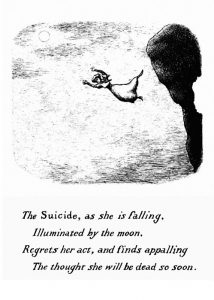
Like we discussed in class, the story seems to offer a comment on natural sin. Though some of the examples in this story are explicit instances of “sin” or even crimes, enacted, there is a psychological root to other examples. People driven to suicide give in to the psychosis of severe depression in any attempt to end their lives. Soldiers (the Zouave) returning from war wrestle with residual violent impulses because of PTSD. Though this is definitely a story about sin, Gorey doesn’t seem to place a heavy-handed blame on every character for the situations they end up in. He intermingles figures acting and being acted upon: the uncle who beats his young nieces and nephews versus the orphan child who perishes in the street. Yet the most troubling examples are those figures who meet failure or doom by their own design, yet as a result of [psychic] forces somewhat beyond their control. I was particularly struck by:

“The Suicide as she is falling/ Illuminated by the moon/ Regrets her act”

Gorey is circling back to acts of impulse and ignorance here, reminding us that they are irrevocable, and often, not without dire consequence. This moment reminded me that despite the macabre trappings of Gorey’s work, he taps into issues that are quite universal, or at least accessible. Statistically, most people who attempt suicide and survive admit that they did indeed instantly regret this act of seeking death. The Wanton, in making herself up with “dangerous” kohl, gives in to not only individual impulse, but also societal pressure for women to achieve beauty through artificial means. The Invalid suffers further because of the mystery of illness, and also because of the failures of his doctors: he is acted upon.

The common thread between every image in this story is the irrevocable nature of each act depicted. The Zouave, conditioned for war, stabs the baby because violence is second nature, and in a single motion, he becomes a child murderer. The suicide gives in to a psychological state that tells her death will relieve the pain of her existence, recovering her will to live only in the moment of limbo before fatal impact. Gorey strikes no middle ground-he draws these figures either right before or right after each one meets his doom or commits his crime. No fates can be reversed in the world or mistakes undone he has created, and though “The Fatal Lozenge” is full of hyperbolic examples, this seems a lesson worth holding on to. A hardened and moderated version of “think before you speak,” Gorey, in a most grim manner,  is counseling the reader (supposedly, the child), to also think before acting.
Amphigorey

I thoroughly enjoyed the work of Edward Gorey’s that we looked at in class this week.  I found the way that he juxtaposes such morbidity with playful verse and rhymes to be incredibly interesting. The artwork is stunning and the collection of verses that go along with the images in many ways add depth and perspective. His twisted and creepy sense of humor is right up my alley, and while I understand that it isn’t for everyone, I’m sure anyone that reads it can at the very least appreciate the way he addresses such dark and morbid topics while maintaining a comical undertone.

Reading it made me analyze more intensely the ways in which children’s books address topics such as death. Books such as Goodnight Mister Tom or Goodbye Mog often times introduce children to the concepts of death, and helps them begin to internalize the fragility of life, and the implications that death carries for the living. I would imagine tackling such subjects with children is difficult, as the questions would be boundless and the concepts would almost certainly not be grasped immediately, but it’s interesting to think about how literature assists in the process of helping children learn about such things.

Gorey certainly chose to take a different creative direction than the authors of the books mentioned above, as he deals with the topic in a more direct and brutal way. The way that he illustrates and writes about the gruesome ends that children meet, or the way in which he speaks about race and murder probably aren’t what most parents are looking for their kids to read. The stories are inherently dark and quite funny (in my opinion at least), but Gorey addresses head on the dark reality that exists beyond the pages, outside of the book. It certainly isn’t a collection of stories I’d recommend for children, as it deals with issues in much more direct and brutal manner than other literature does.

A Gorey Kind of Funny

While reading through Edward Gorey’s “Amphigorey”, I found that most of the stories were characterized by either gloomy subject matter or satirical commentary. What results from this, I think, is the communication of frequently used story lines and narratives in a completely new form and sometimes, with a dissimilar ending. For example, the Bug Book tells a story dominated by social stratification of groups with the exclusion of those who do not conform. But instead of ending the story with this morality or somehow allowing justice to be had for the ostracized bug, the story ends with the it being killed by the others. Consequently, they are able to continue acting the way they do at the expense of and with the exclusion of others. This is also displayed in the alphabet section entitled, “The Gashlycrumb Tinies” , which categorizes each letter by something somber in nature. One example is, “C is for Clara who wasted away”, another one being, “I is for Ida who drowned in a lake”. Gorey uses format of a child’s learning tool – the alphabet, the very basis of our language – and characterizes it by different forms of death. What are the implications of this choice? Is this simply a stylistic choice, or is Gorey trying to communicate something specific to the reader?

css.php