
The relationship between an illustration and an illumination is subtle. An artist’s illustration is their interpretation and representation of something. In the following example, the original artist, Vincent van Gogh, illustrated a scene where he was living. When creating the painting, Van Gogh made his own decisions on what parts of the scenery he wanted to emphasize. In an illumination of van Gogh’s painting, Dean Russo chose to emphasize different portions of the illustration to heighten the importance of aspects that he found interesting.

The painting Starry Night, by Vincent van Gogh is a well known piece of artwork that represents van Gogh’s illustration of the view from his bedroom at the Saint- Remy-de- Provence. The painting shows a small town that is surrounded by mountains. Van Gogh emphasizes the night sky, which takes up almost half of the painting. The sky is made up of an intricate mixture of blues and white that illustrate the clouds and sky itself. The stars and moon are surrounded by yellow “clouds” that highlight the light they give off. In contrast, the colors used for the mountains and the buildings are dull and dark, in part because the painting is set during the night. The brighter colors used in the top half of the painting draw the eye to the sky and the details found there.
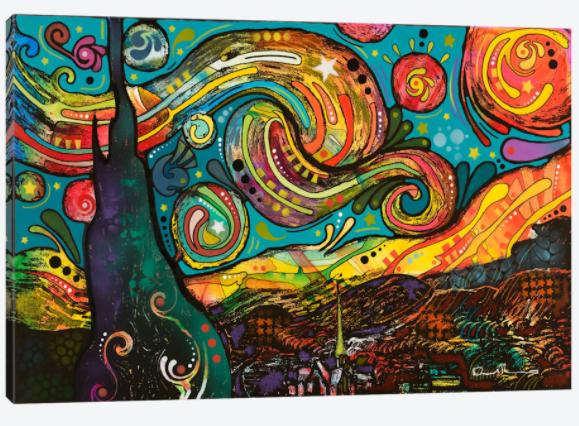
The illumination of Starry Night, by Dean Russo, emphasizes the sky, but interestingly also places emphasis on the mountains surrounding the town. In contrast to the dark blues that van Gogh used to illustrate the mountains, Russo chose to illuminate the mountains by painting them in vibrant yellows and oranges. Even though Russo used bright colors to illuminate the swirls in the clouds, the eye is drawn more strongly to the mountains. Although Russo used a wider variety of colors throughout the whole painting, the illumination of the mountains and clouds is obvious in contrast to the duller colors found in the rest of the painting.

I found this post very interesting specifically because of your interpretation and understanding of the differences between illustration and illumination. I have often thought that illumination can really be used to highlight what the true meaning and importance of a work of art. I think it also shows the history of illumination in art work which is what I discussed in my blog post from this week. Finally, I feel like your choice of Van Gogh’s Starry Night compared to Dean Russo’s interpretation really is a great example of this.
Your comparison of an illustration and an illumination of Van Gogh’s “Starry Night” underscores the myriad possibilities for visual interpretations of the same scene. To me, Russo’s illumination of “Starry Night” stands in stark contrast to Van Gogh’s original, particularly in its use of color. Russo’s piece is afire with vibrant hues, with hardly a hint of the darker, enigmatic atmosphere in Van Gogh’s work. It is almost as if it’s not night at all. This prompts the viewer to reflect on the subjectivity of visual interpretation, and the way in which the tweaking of a single element in a work of art can transform its entire meaning. I would be interested to read Russo’s vision of this “Starry Night,” to understand the mood this illumination conveys and to further explore the dissonance between his work and the original.