Great Art as a Threat to God’s Power

In Chapter 28 of My Name Is Red, which is narrated by the murderer, the speaker discusses the tenuous boundaries between artistry and blasphemy. Speaking to Enishte Effendi, he proclaims, “The greatest of sins is committed by painters who presume to do what He does, who claim to be as creative as He” (160). Artists might express a creativity superior to God not only through a public declaration of this fact. This is why eastern art discourages the development of individual style-for fear that an artist’s singular creative brand will overshadow’s God’s creation(s). Thus recognition, too, in Eastern culture, becomes a nonissue. For to proudly claim one’s work is to boast of one’s craftsmanship-to set oneself on the same plane as God Himself.

The precariousness of this boundary is familiar in other realms beyond art. For example, in Puritan New England, those who wished to become members of the congregation were required to give testimonies of faith. Still, in these testimonies, testifiers and church members alike were hyper-aware of crossing the line towards forbidden knowledge. There was a great fear of disrespecting God and pushing into realms where humans did not belong by, almost accidentally, accessing this higher knowledge.

In both eastern and western cultures centuries ago, religion permeated every realm of society, and became, in some respects, a restrictive force. The illuminators in My Name is Red are bound by a requirement to respect God, to curb artistic liberty in order to maintain this dedication to one’s faith. It was not only reverence, and perhaps more so fear that kept artists in line. To surpass God in any endeavor, particularly creative, was inconceivable. Punishment for such a transgression was too, horrifying yet unthinkable. In this climate of apprehension, most artists wouldn’t dare cross the threshold to create anything that even potentially compared to God’s work. Fear of this transgression is at the root of Elegant Effendi’s objection to the project of the secret book. Yet in refusal of this belief that their work could be blasphemous, the speaker murders him.

The murderer and Enishte Effendi seem to concur that artistic liberty  and success can be divorced from irreverence. Pamuk alludes to the fact that this is an idea which came to the West much sooner than the East. Could masterful artistic works, rather than casting doubt upon God’s authority and creativity, in fact underscore his Glory and his exalted position in the human world? Effendi pushes for the completion of the book seemingly ripe with this belief.

 

Objects vs. their meaning in art

In the chapter “I Am Tree” from  My Name is Red, an illustrated tree from an illuminated manuscript actively distinguishes itself from the more intentional and realistic figures found in European art. This foreshadows the conflict at the heart of the book-the disparity between Islamic and European art and the way it reflects traditions of culture and of faith. The tree denounces the aspiration to realism and attention to detail in European art, clinging desperately to the decorative tradition of Islamic art.

The chapter closes with a declaration: “I don’t want to be a tree, I want to be its meaning.”  Through the voice of the tree, Pamuk suggests that Islamic art (of the time) demanded a clean separation between art and life. Art is ornamental, fabricated, ethereal. The presence of the colloquial, of the faces of friends and community members in an artistic work, diminished its magic. The tree continues, “I thank Allah that I, the humble tree before you, have not been drawn with such intent.” In rejecting intent, the tree suggests an appreciation of the spontaneity and artistic liberty that characterizes  the creative process in illumination. Illuminators were not necessarily given rigid instructions, and instead offered the freedom to articulation individual visions. In contrast, European artists were confined by the aspiration to imitate life as closely as possible, essentially unable to express individual styles.

Pamuk then draws a distinction between an object and its meaning. The object is plain and two dimensional, simple and undeserving of further explanation. Meaning can be entirely separate, and alive, animated, but not necessarily attached to its real life object. The tree in the manuscript declares itself “the meaning of a tree,” as separate from the tree itself.

The issues that the tree raises reminded me of the Magritte painting, La trahison des images. Viewers have to think about the nature and meaning of images in this work…Is this a pipe, or is this a picture of a pipe?
The statement below the illustration declares, “This is not a pipe.”

Magritte at once acknowledges and pokes fun at the ambiguous language that blurs the separation between an image and a real object. The tree probes a similar distinction, yet declares one superior to the other. Meaning:  liberal artistic expression rises above the actual object or any attempt to realistically imitate it.

Paratext in Nonfiction Books

If nonfiction is considered a genre of “truth,” how do these authors understand and approach the issue of paratext when their works are published? Paratext sets the authors at a disadvantage, placing the interpretation of their words one step further beyond their control. And in particular with nonfiction, I wonder if the danger of including some elements of paratext, particularly cover art. The truth and meaning of the text belongs, in disparate moments, to the author, and to each reader. Yet the design of any book cover inevitably influences the reader’s understanding—you see before you read.

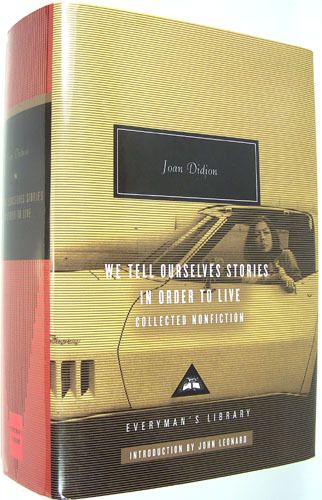
Joan Didion, one of my favorite authors, is something of an icon in the writing world. At once, a widespread reverence for her talent as a prose writer has given way in recent years to a commercialization of her image and brand. Her crisp taste, her minimalist aesthetic, and ability to simultaneously reflect upon and dismiss the blundesr of her youth are the envy of many a twenty something woman today. The cover of The Everyman’s Library anthology of Joan Didion’s nonfiction, We Tell Ourselves Stories in Order to Live, is plastered with the now cliché image of a young Joan leaning out the window of a convertible, looking ill-amused, cigarette dangling loosely from her right hand. This image fails to encompass Didion’s language, narrows her persona, and freezes her in youth. It does not do justice to the full scope of her prose—the breadth and depth of each essay, the deftness of her syntax.

So I wonder whether, for the sake of a genre that is, by definition, grounded in the real, nonfiction books might do better without cover art. If book covers were blank, would people still read? Without titles and cover art? With only words? And yet our visually oversaturated society calls, always, for images. Sometimes, it seems, for pictures before language in a world where the written word is increasingly phasing out of fashion. We cannot realistically afford to eliminate the visual. The connection between images and text and the space between them is flush with meaning. Yet as readers of nonfiction, it seems we are obligated to attempt to access the author’s story in its purest from. We owe it to them not to fictionalize fact.  At root, then, does paratext cheapen nonfiction text?

Cover of We Tell Ourselves Stories in Order to Live
css.php