Complexity of Portrayal

In  “My Name is Red,” ideas and concepts are presented to miniaturists that one might assume are impossible to portray in picture form. One instance, in Chapter 24 (“I am Death”), a tall, mysterious old man tells a miniaturist, “Now then, draw Death for me”. The miniaturist responds, “I cannot draw a picture of Death without ever, not once in my entire life, having seen a picture of Death”. The wise old man argues back, “You do not always need to have seen an illustration of something in order to depict that thing” (Pamuk 125).

The old man’s response brought me back to my childhood when I would read picture books every night before bed. The books were typically educational, and sought to teach me (and any other children reading them) about life values or concepts. For instance, showing gratitude. How does one depict a lofty idea like gratitude?

Our study of images thus far in the course has made me reevaluate my question. In illuminated manuscripts like the Très Riches Heures, ideas and concepts are portrayed all the time. Patrons want to be seen as kind, and want their servants to be depicted as happy. Therefore, one must depict what they feel about happiness or kindness, portray what comes to mind, and make the viewer feel it too. It is personal interpretation that sparks audience interpretation. Is this always effective? Do we always succeed? Likely not, but it is the attempt to do so that gets any artist one step closer to reaching his/her viewers.
Are manuscripts biased in perspective?

Thus far, our class conversation surrounding illuminated manuscripts has made it apparent that the primary creators of these works were male. Recently, in my Sexuality & Gender of Ancient Greece and Rome classics course, we’ve discussed the problem of male-centered primary resources. I think this dialogue could be extended to works such as Très Riches Heures or the Book of Kells.

The question becomes, are we making assumptions and associations of a time period based on a male-dominated perspective? Are we truly understanding stories of the time if we are only receiving half the story? These illuminators have the ability to portray whatever it is they would like, as we discussed with their ability to incorporate their patrons into works with either kind or snarky effects. This makes me wonder if their representation of culture are swayed or inaccurate. I’m curious to hear other people’s thoughts on the matter.


Banksy + Metapictures

After class this morning, I left wanting to look at more Banksy graffiti art. Whether you believe graffiti is vandalism or not, the artistry and commentary behind Banksy’s work is both relevant and inspiring.

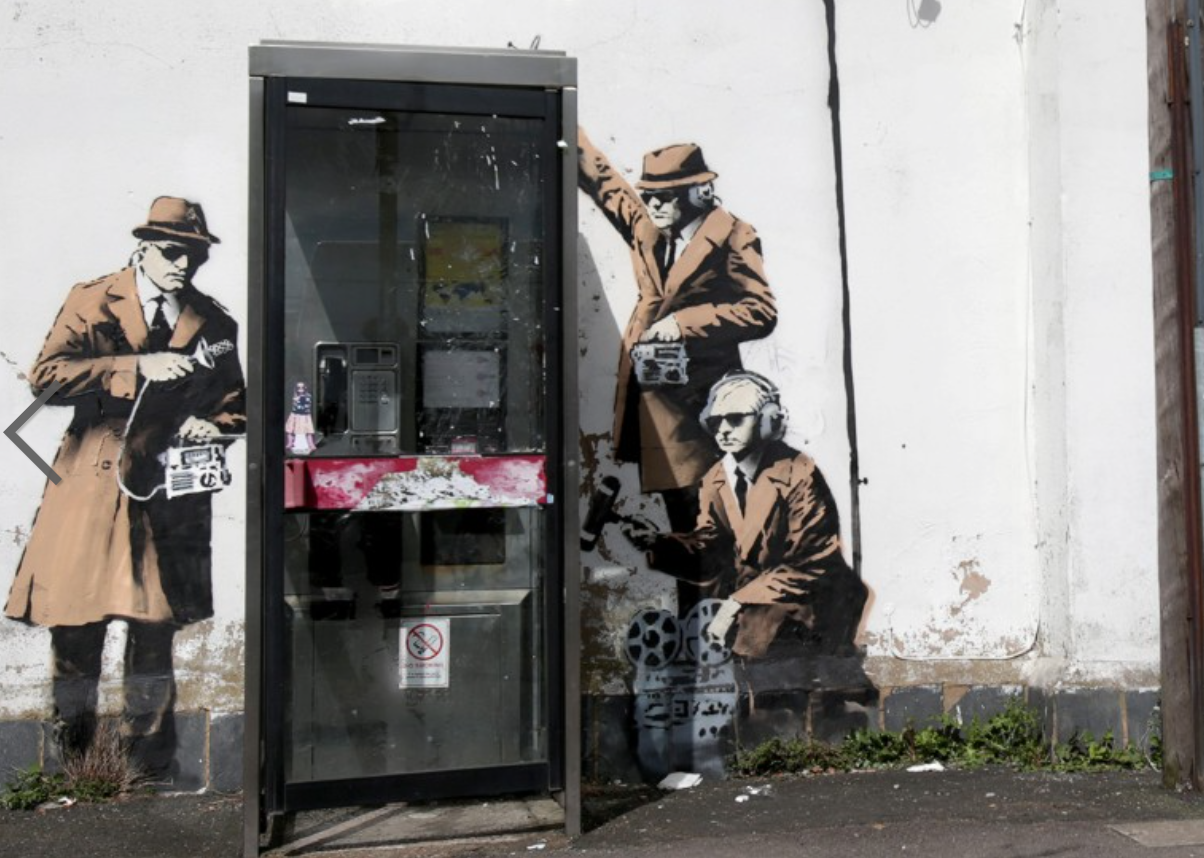
Metapictures, as defined by Mitchell in Picture Theory, are “pictures that refer to themselves or to other pictures; pictures that are used to show what a picture is” (Mitchell 35). In class, we discussed how Banksy creates artwork that seamlessly utilizes the exterior world as part of the display. These meta-“graffitis” are incredible to analyze. After class, I found this Banksy image online:

This Banksy creation was done on the side of a house near the UK Government Communications Headquarters. Three men dressed in trench coats “wait” patiently next to a telephone booth with recorders, microphones, and camera equipment. To me, the artwork seems to suggest a lack of privacy. Potentially, even deeper, commenting on encroaching government surveillance… especially due to it’s location. Not only does this piece kind of make me laugh (as it’s pretty comical to envision yourself going into the telephone booth), it also makes me think critically about government surveillance. Are we being watched at every turn?

By simply incorporating the outside world (aka the telephone booth) into the piece, Banksy successfully creates a metapicture worth talking about.

css.php