Complexity of Portrayal

In  “My Name is Red,” ideas and concepts are presented to miniaturists that one might assume are impossible to portray in picture form. One instance, in Chapter 24 (“I am Death”), a tall, mysterious old man tells a miniaturist, “Now then, draw Death for me”. The miniaturist responds, “I cannot draw a picture of Death without ever, not once in my entire life, having seen a picture of Death”. The wise old man argues back, “You do not always need to have seen an illustration of something in order to depict that thing” (Pamuk 125).

The old man’s response brought me back to my childhood when I would read picture books every night before bed. The books were typically educational, and sought to teach me (and any other children reading them) about life values or concepts. For instance, showing gratitude. How does one depict a lofty idea like gratitude?

Our study of images thus far in the course has made me reevaluate my question. In illuminated manuscripts like the Très Riches Heures, ideas and concepts are portrayed all the time. Patrons want to be seen as kind, and want their servants to be depicted as happy. Therefore, one must depict what they feel about happiness or kindness, portray what comes to mind, and make the viewer feel it too. It is personal interpretation that sparks audience interpretation. Is this always effective? Do we always succeed? Likely not, but it is the attempt to do so that gets any artist one step closer to reaching his/her viewers.
Thinking About How Art Was Supposed To Be Viewed…

During today’s class I was particularly intrigued by the exercise we did with the Persian documents. We compared how the documents looked with the lights on and with the lights off. As a class, we concluded that there was a difference when the documents were looked upon under a different lighting.

Seeing as these documents were constructed in the 16th century, they were not created when electricity was invented. Present day individuals forget that a great percentage of the artwork they view is not in its intended situation from when it was created. For example, we read Shakespeare plays as if they were novels. However, Shakespeare never intended his plays to be read, rather they should have only been viewed as a performance. When we relate this information back to the Persian documents, our reaction when the lights were turned off is most likely how these pieces of art were viewed at the time of their creation. While candles and natural light existed in the 16th century, modern lighting has manipulated the way we view these documents in present day. It is interesting to think about how we view art and how it was intended to be seen when it was created.

It Is… Yet It Isn’t

My Name is Red by Orhan Pamuk is definitely a challenging read. It is a book that requires the reader to critically think throughout. With all of the different characters that tell their story, it can be difficult to know when to take the words in the book literally, and when to use critical thinking to make sense of the story. 

The chapter “I am a Tree,” requires the reader to think a little harder to understand what is going on. I had many questions at the beginning of the chapter. Why does a tree have a chapter to itself? How can a tree even speak? What is the importance of this tree to the story as a whole? It seemed like a completely random decision by Pamuk, but the more I am reading, the more I am realizing how deliberate Pamuk is with every word choice he makes in this book. I became aware of the connection of the tree to the book in the very last paragraph of the chapter.

“I the humble tree before you, have not been drawn with such intent. And not because I fear that if I’d been thus depicted all the dogs in Istanbul would assume I was a real tree and piss on me: I don’t want to be a tree, I want to be its meaning.” (Pamuk, 51)

After reading this, I realized that that tree was a picture all along. This explains why it belongs in a book about illuminations. The tree had actually simultaneously given the perfect description as well as an example of a meta picture, which is a picture about itself. 

This reminded me of the  image above. The caption translates to, “This is not a pipe.” Scott McCloud explained in his book Understanding Comics: The Invisible Art that the image means to say that is a picture of a pipe and not a real, tangible pipe itself. Yet another meta picture.


Metafiction

In class up to this point, a good portion of our time has been spent discussing the concept of metapictures (images that in some way acknowledge their essence as pictures, and comment upon themselves). In Orhan Pamuk’s novel, My Name Is Red, we encounter for the first time what I believe to be a related concept, metafiction. While there have been several examples of metafiction present in the portion of the novel that I have completed, the most powerful and clear cut example came in the third chapter, which is titled I Am A Dog. In this chapter the dog, who is the narrator, says, “I’m a dog, and because you humans are less rational beasts than I, you’re telling yourselves, ‘Dogs don’t talk.’ Nevertheless, you seem to believe in a story in which corpses speak and characters use words they couldn’t possibly know” (Pamuk, 11). It is clear to see here, especially in the final sentence of the excerpt, that the dog is in fact addressing the reader, and in doing so the dog makes clear that they know they’re a character within a novel. The dog comments upon it’s reality within the pages of the book by addressing the reader. Throughout his novel, Pamuk has self-consciously alluded to the artificiality of his work by departing from traditional novelistic conventions and employing the use of metafiction. I’m interested to see if Pamuk uses this technique at other points later in the novel.

Art Beyond What is Accepted

After today’s class, there was one quote that we were reviewing from My Name is Red which truly stood out to me.  This quote was, “Painting is the silence of thought and the music of sight.”  I found this to be an incredibly important quote because it truly gets at the essence of the issue of this book.  Is it an illuminators job to just blindly produce images that are accepted by society, or is it the artists job to represent and express their emotions and use these emotions to depict the world they see around them?  Pamuk writes an entire novel of the transition from an Eastern world to a Western world, and how art and culture are developed as a result of this.  The quote above highlights the same transition from creating art that is thought to be appropriate to the public to creating art that shows true artistic expression.  I also find that he calls it “the music of sight” because yes these artists are producing what they see, but the “music” comes from their idealization of reality.  This use of idealization was extremely common in Western 16th century art.

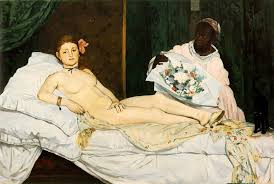
An example where I can see this transition is the first image we saw in class today that represented the love story that Pamuk’s novel is based on.  The artist is rejecting common ideals and notions for what is acceptable in Eastern culture.  It is completely new to have a man gazing upon a nude woman, who at the same time invites her in with her gaze.  This is also seen when the Modernist artists beginning in the 19th century began developing what was acceptable in art with regards to nudity and gazing.  Prior to this movement only nymphs and gods were depicted naked, but now they were allowing ordinary women to be naked, and they were accepting the viewers gaze at the same time.  This can be seen in Edoard Manet’s Olympia (1856).

She was not a goddess or a nymph, but still was the sole focus of a painting and was completely nude.  She also was staring directly at the viewer drawing their attention to her nude figure.  So truly being an artist and painting is more than just the thought of the spectator and the thought of what is acceptable, but art is about the music in an artist’s soul.

I Am A Tree

“I don’t want to be a tree, I want to be its meaning.” – I Am A Tree, p. 51

This chapter is written from the perspective of a tree, which was drawn on a sheet of paper that was meant to be included in a manuscript, but never made it into the final product. Immediately before this quote, the narrative voice of the tree states that they are glad they are not drawn in the new style, in which a tree would be drawn in such detail that anyone looking at the picture could select that particular tree out of all the trees in a forest.

This quote leads me to question how it is possible to depict the meaning of a tree. Can the meaning of a tree be conveyed without drawing the tree in great detail? When creating an illumination, an artist strives to uncover the meaning of a scene or object. But as the audience views the illumination, they are left with their interpretation of what they see. The meaning of the tree will first be filtered through the mind of the artist and then through the mind of the audience.

This quote, when taken with the text before it, seems to suggest that the new style of of painting involves the addition of great detail, but the loss of the meaning behind the painting. This thought was counterintuitive to me, because I would normally think that the addition of detail expresses the meaning of an illumination more fully. Perhaps this tree was meant to be a symbol of something greater and by adding detail to the tree, the audience is distracted from that symbolism.

November/December vs. The World

I’ve been looking at the Très Riches Heures a lot over the past couple of days, and one of the questions I’ve been asking myself is why the last couple months of the calendar (completed by a different artist) are considered problematic. I guess it’s just because the brothers who did most of the work didn’t live to complete it, and people are sad for the sake of their vision. That’s all I can do to account for it, because November and December appeal to me more the other plates.

Of course, my personal preference has nothing to do with their worth as judged by art historians and critics. But from my own experience I can say that these two illuminations remind me more of more modern paintings. Their shadowy nature, the encroaching woods, the dark backgrounds and red clothing, and peasants featured as protagonists all remind me a little of Dutch and German renaissance paintings.

You know, things kind of like these. November and December aren’t nearly as sophisticated, but they’re closer, I’d say, to later art than the rest of the Très Riches Heures. That might make them a poorer example of a medieval manuscript (and I will admit that they aren’t nearly as colorful), but it doesn’t make them poorer artworks. It’s to the credit of the artist that he branched out.

My Name is Red Paratext

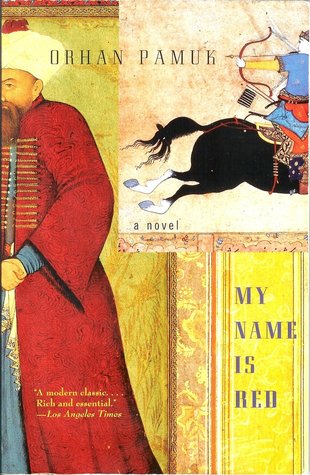
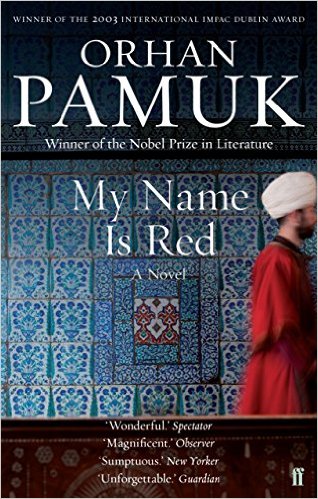
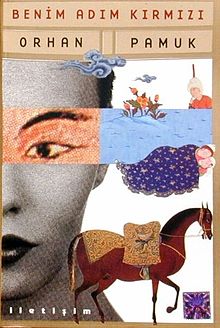
In class we discussed how Orhan Pamuk emphasizes the importance of vision and seeing not only to experience illustration, but also to question the world around us.  I though it would be interesting to incorporate what we’ve learned about paratext from previous classes into how one sees and reacts to the cover art of this literary work. Below are a few covers:

The first one is most similar to the one I own. My initial reaction was that this is an eastern novel, but other than that it was difficult for me to predict what the plot could be. Now I realize that this was intentional because it’s a mystery that leaves room for a lot of interpretation.

The second cover also informs me that the novel embodies something of eastern culture, but shows this with more religious undertones than the first one. I think by incorporating the intricate arabesque as a major focal point, connotations of religion, specifically Islam, naturally drift into the viewer’s head. Also, it seems as if this cover is more wordy than the other three, but I think that may be due to the structural arrangement. By centering the words, it is evident that western ways of composition have influenced eastern publications.

The third cover is similar to the first cover in that by only showing half of the woman’s face and providing a collage of various natural elements, the plot and its’ meaning remain enigmatic. In my opinion, out of the four covers shown, this one is the least westernized.

For the final cover, my initial reaction was that it combined modern and aged elements. The font and structure makes it seem like an advertisement I’d see today in the west, but the aged style and color of the image makes me believe the novel eastern. Again, the battle between eastern and western ideas.

I think all of these covers show the main theme of the book that deals with conflict between western and eastern illumination.  What cover do you think is the best at representing the visual and textual messages of the novel? What were your initial reactions to viewing these covers?

I Am a Dog

The Persian manuscript of the dog (possibly tiger, but let’s go with dog) made revisit chapter 3 in My Name is Red, “I Am a Dog.” I found two quotes in this chapter to be particularly interesting, the first: “By pointing out this affection shown to the cat, which has incidentally been denied to us dogs, and due to our eternal feud with this feline beast, which even the stupidest of men recognizes as an ingrate, people have tried to intimate that the Prophet himself disliked dogs” (12). This quote follows the description of Muhammad cutting his robe as to not disturb a sleeping cat. I think this quote undermines Islam, and religion in general, by pointing out how far fetch such interpretations can stem from. The dog speaking in this chapter thinks it is unfair that humans have such animosity towards dogs because of their relationship to the cat. The dog, however, cannot seem to stick to one side of the argument.

In attempt to defend all canines, the dog cites a chapter of the Koran where seven men sleep for three hundred and nine years and awake attached to Allah. The dog notes that the eighteenth verse mentions a dog resting outside the cave and concludes, “as a dog, I take pride in this chapter, and through it I intend to bring the Erzurumis, who refer to their enemies as dirty mongrels, to their senses” (13). After implying that interpretations of prophet Muhammad’s actions were dubious, the dog then references the Koran for an explanation not all that different from the logic he is trying to refute.

The dog seems to be using the same flawed evidence that he is denouncing. Could this represent the struggle between the East and West? Is the dog being facetious when he references the Koran for evidence of dog’s loyalty and protection?

Original vs. Counterfeit – Is one really more valuable than the other?

In the 1966 film How to Steal  A Million, Nicole’s father makes his living selling replications of famous works of art. While I understand the criminality in the practice of claiming art to be created by another, more famous, artist, I never could quite grasp why a counterfeit piece of art was never as valued as its original. Nicole’s father is clearly talented, maybe even more so than the artists he copies because he has the skill to replicate, and to replicate so well he can deceive art experts. Why are these counterfeit artists not celebrated?

This question arose again the other day while looking at Trés Riches. Before the completion of the calendar, the two artists died. Thus, in order to finish the book, another artist was commissioned to create the months of November and December. Maybe it’s because I don’t have that well trained of an eye in regards to illuminations (yet), I would not have been able to tell the difference between November/December and the other ten months of the calendar. It was only when Professor Serrano commented that it was a “shame” to not have the entire calendar completed by the original artists.

Again, I ask why? Why are these two months not as respected as the others? Are they not as well crafted? Or is it simply because they are not the works of the Limbourg brothers?

With this question in mind, it was interesting reading the chapter “I Am a Gold Coin” from Orhan Pamuk’s My Name is Red. If a replicated painting were animated, I’m sure it would feel just as the gold coin feels – neglected and fearful of being discovered as a fake. The gold coin explains:

“A broker, not recognizing that I’m counterfeit, who has counted out 120 silver coins in exchange for me, will berate himself in fits of anger, sorrow and impatience as soon as he learns he’s been cheated, and these fits won’t subside until he rids himself of me by cheating another” – pg. 104

Despite the fact that the coin is a fake, it has successfully travelled and been exchanged as a valid coin for seven years. However, even though the coin has been used for the same function as a real coin, as soon as it is discovered as a fake, all its value is lost.

I guess my main question is – how do we decide what is valued and what is not, especially when the two objects (whether they be two paintings or two coins) are identical therefore created with the same labor and effort?

css.php